
Hampton County Arrest Records and Charges
Hampton County arrest records begin with the agency side of a criminal event. Sheriff Anthony "Bubba" Russell's office, municipal police, or another law-enforcement agency may create incident, arrest, booking, or custody records. Those records can identify the person arrested, the agency, the date, the reported offense, and related report information when public. Booking and custody status are different from court charges and should be checked through the jail or custody tools when the question is current detention.
Charges after arrest are the formal accusations that move into court. In Hampton County, the Clerk accepts and maintains criminal warrants, sends warrant information to the 14th Circuit Solicitor for indictment preparation, and later updates the court file after disposition. The arrest side helps explain why a person entered the system. The court charge record explains what the state filed and how each charge changed. Current jail status belongs with Hampton County inmate records, while the full court case and sentence belong with criminal court records.
The first assigned source image is the Hampton County Sheriff's Office homepage.

The Sheriff's Office is the practical starting point for law-enforcement records, tips, app access, and FOIA requests tied to arrest records.
Find Hampton County Arrest Records
There is no official Hampton County public mugshot or active arrest-record database in the research. The official route depends on what is being checked. Use the Sheriff or Detention Center for arrest, incident, custody, or jail information. Use the Hampton Public Index and court offices for court charges after arrest. Use SLED CATCH for a paid statewide name-based criminal-history check, while remembering that CATCH is not a warrant search and does not check sex offender registration.
- Identify whether the request concerns an arrest report, current custody, a warrant, a court charge, or a final criminal case outcome.
- Check the Hampton Public Index for public court charge and case-status information tied to a filed case.
- Contact the Sheriff's Office or Detention Center for law-enforcement or custody questions that are not answered online.
- Use the Sheriff's FOIA form when a police report, arrest report, or related public record must be requested formally.
- Use SLED CATCH only for statewide name-based criminal-history checks, not for wanted-person, custody, or sex-offender searches.
The Sheriff's FAQ image source is the Hampton County Sheriff's Office frequent questions page.
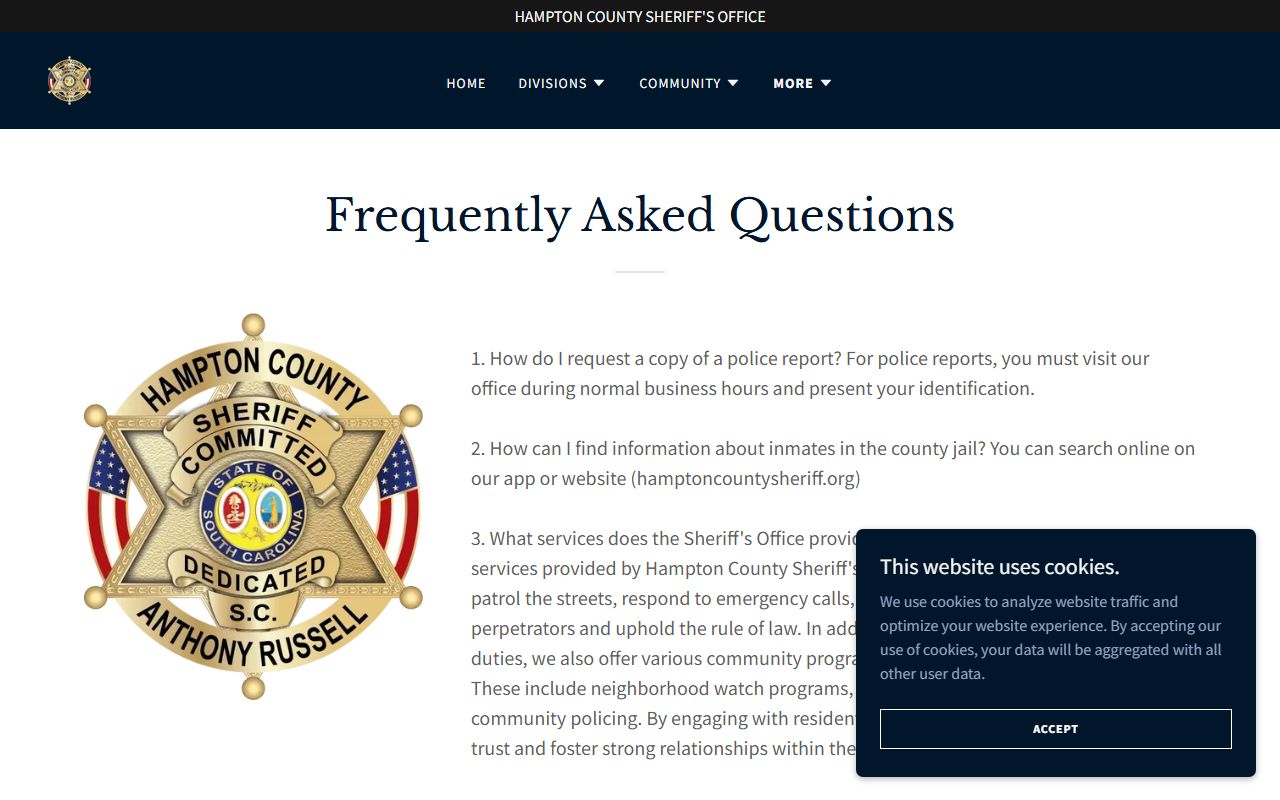
The FAQ supports the access chain because it points users toward app or website inmate information, police report requests, complaint methods, tips, and after-hours contacts.
Charges After Arrest in Hampton County
After an arrest, the court charge record develops through a formal filing path. Hampton County General Sessions research states that Clerk of Court Jvonndra Brooks-Creech's office accepts criminal warrants, maintains them, and transmits warrant information to the Solicitor for indictment preparation at Hampton County Courthouse. The Solicitor is South Carolina's elected prosecutor and handles Hampton County General Sessions prosecutions within the 14th Judicial Circuit.
| Complaint or Warrant | Information | Indictment | |
|---|---|---|---|
| Filed or prepared by | Law enforcement, magistrate process, or prosecutor-linked warrant path. | Prosecutor filing where allowed by procedure. | Prepared through the Solicitor process for General Sessions prosecution. |
| Common use | Initial accusation, arrest, bond, or lower-court charge basis. | Formal prosecutor charge in a case path when applicable. | General Sessions felony or serious criminal prosecution path. |
| Where it appears | Warrant records, Magistrate Court, bond records, or court case file. | Court file and docket if used. | General Sessions court file and docket. |
| Why it matters | Links the arrest to the first court action. | Shows the prosecutor's formal accusation. | Shows the Solicitor's formal charge route for Circuit Court criminal cases. |
The formal FOIA source image is the Hampton County Sheriff's Office FOIA request form.
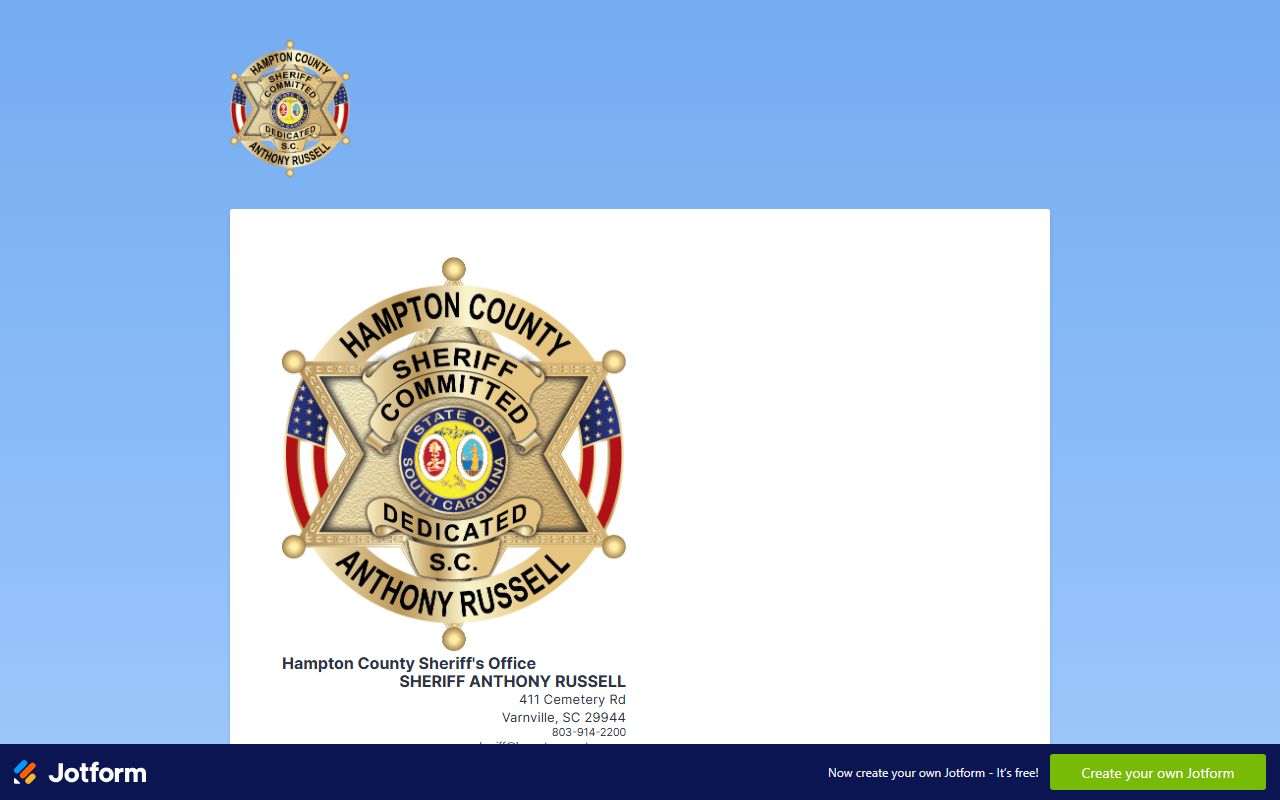
The FOIA form is the fallback when an arrest or report record is not available through a public web tool.
Hampton County Charge Status
Charge status matters because one arrest can produce several charges, and each charge can follow a different path. A charge may be pending, amended, reduced, dismissed, nolle prossed, or resolved by plea or trial. Hampton County General Sessions files may include disposition, fines, fees, and updates after the court term. Those status fields should be read before drawing conclusions from an arrest or early charge listing.
| Status | What It Means |
|---|---|
| Pending | The charge remains open or unresolved in the court record. |
| Amended | The charge text, statute, level, or related allegation changed after filing. |
| Reduced | The charge moved to a lower offense level or less serious allegation. |
| Dismissed | The court record shows the charge ended without a conviction on that charge. |
| Nolle prossed | The prosecutor dismissed or chose not to pursue the charge. |
| Convicted | The record shows guilt by plea, verdict, or qualifying court finding. |
The sex offender registry source image is the Hampton County SLED sex offender registry entry.
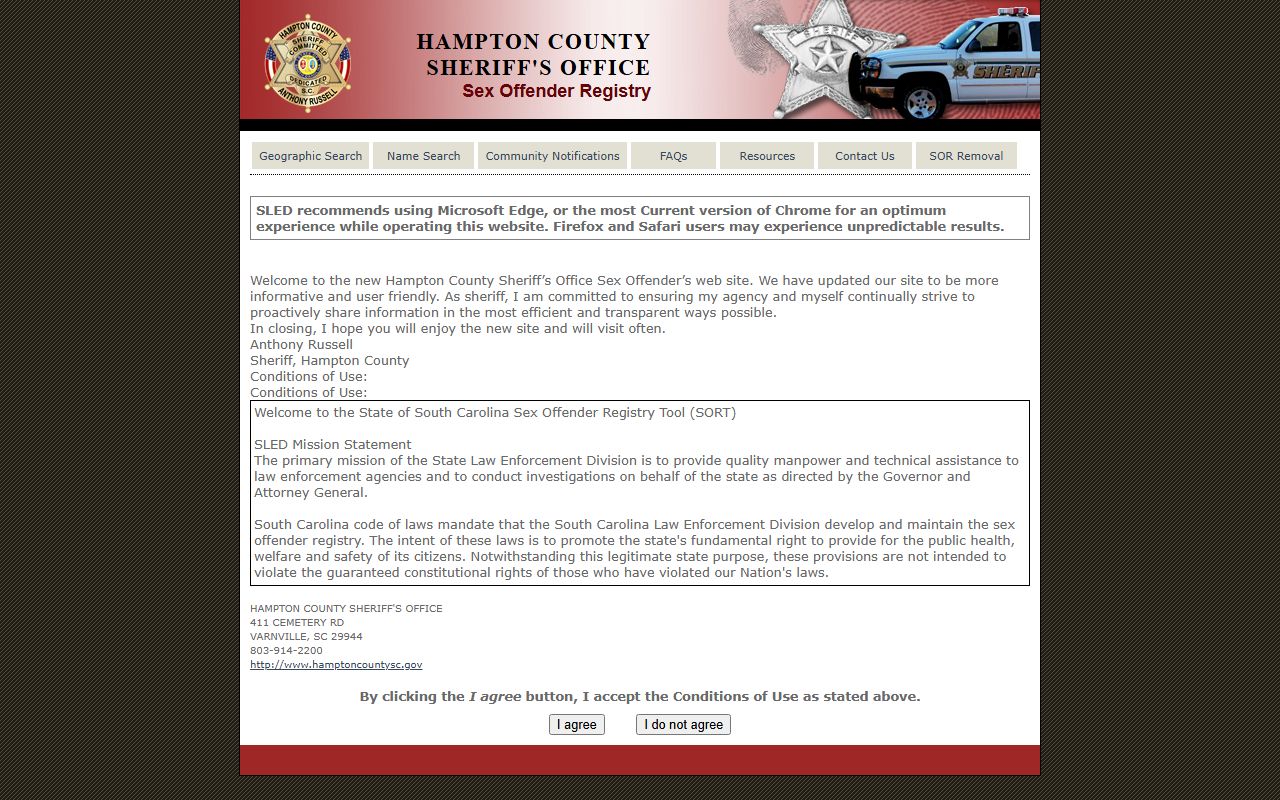
The registry is separate from arrest records and court charges, but the research flags it as an official SLED path that users often confuse with criminal-history checks.
Charges vs. Convictions
An arrest record and a charge record should never be treated as proof of conviction. Arrest means a person was taken into custody or cited through law enforcement. A charge means the state accused the person of a crime. A conviction means the court record shows guilt was established or admitted. Hampton County charge records can show dismissed, reduced, or nolle prossed charges that never became convictions.
| Charge | Conviction | |
|---|---|---|
| Meaning | An accusation filed or pursued by the state. | A court outcome after plea, verdict, or equivalent finding. |
| Timing | Early or mid-case, after arrest or warrant activity. | At disposition or sentencing. |
| Record clue | May show pending, amended, reduced, dismissed, or nolle prossed. | Should connect to disposition and sentence. |
| Use caution | Does not prove guilt. | Still may be sealed or expunged if eligible under law. |
Statewide Charge and History Lookups
SLED CATCH is the official paid South Carolina name-based criminal-history path found in the research. It is not the same as a Hampton County arrest record, jail roster, court docket, or warrant search. The research states that SLED CATCH costs $25 plus a $1 convenience fee for a standard check, with a reduced $8 fee for eligible charities. It explicitly excludes Wanted Persons information and does not check sex offender registration.
The state-history source image is the SLED CATCH criminal-history search.
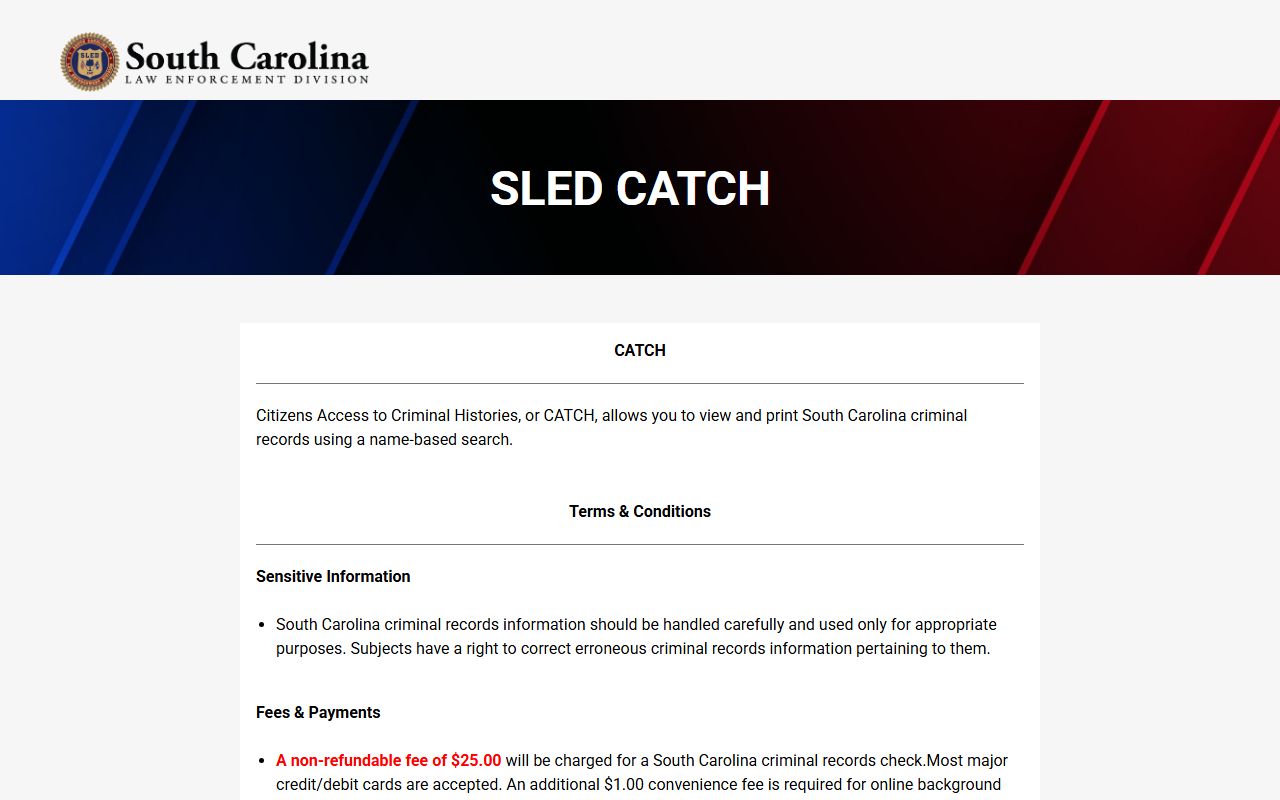
SLED CATCH can help with a statewide criminal-history question, but Hampton County court charge status still needs the court record and disposition.
Important: SLED CATCH is not a public wanted-person search, and it does not replace direct court or Sheriff contact.
Arrest Record Requests and Fees
When a Hampton County arrest or incident record is not available online, the Sheriff's FOIA form is the official request path identified in the research. The form asks for the requester name or business, address, phone number, case number if known, type of report, specific date or date range, date the event happened, description, reason for request, and signature.
| Sheriff FOIA Item | Amount or Rule |
|---|---|
| Search, retrieval, and redaction | $22 per hour. |
| CD or DVD | $5 each. |
| Black-and-white letter page | $0.25 per page. |
| Color letter page | $0.75 per page. |
| Black-and-white legal page | $0.50 per page. |
| Color legal page | $1.00 per page. |
| Deposit | 25 percent deposit required, with payment in full before release. |
Hampton County Sheriff's Office
411 Cemetery Road
Varnville, SC 29944
803-914-2200
Monday-Friday, 8:00 a.m.-5:00 p.m.
Hampton County Detention Center
409 Cemetery Road
Varnville, SC 29944
803-914-2223
Sentenced and unsentenced inmate custody questions.
Restricted Hampton County Charge Records
Some arrest and charge records are not open for routine public viewing. Juvenile records are confidential under South Carolina law. Family Court criminal-related juvenile matters can be restricted. Adoption, child-protection, sealed, and expunged records also have statutory or court-order limits. Rule 41.2 and South Carolina privacy provisions require personal identifiers to be redacted from public filings.
Expungement can affect both arrest and charge records. South Carolina Judicial Branch says expungement removes a criminal conviction or charge and seals or destroys the state's records of the arrest, charge, or conviction when eligible. General Sessions and juvenile expungement applications start with the Solicitor in the circuit where the offense occurred. Magistrate and municipal dismissed, not-guilty, or nolle prossed cases have a separate summary-court process under state law.
| Sealed | Expunged | |
|---|---|---|
| Public display | Hidden from ordinary public access. | Removed, sealed, or destroyed when the law allows. |
| Cause | Court order, court rule, confidentiality statute, or protected record type. | Approved expungement process and court order. |
| Record types | Juvenile, adoption, abuse and neglect, sealed court records, certain Family Court files. | Eligible arrest, charge, conviction, dismissed, not-guilty, nolle prossed, or juvenile records. |
| Local route | Ask the record-holding court about inspection authority. | General Sessions applications route through the 14th Circuit Solicitor. |
The final assigned source image is the SCCID county public defender directory.
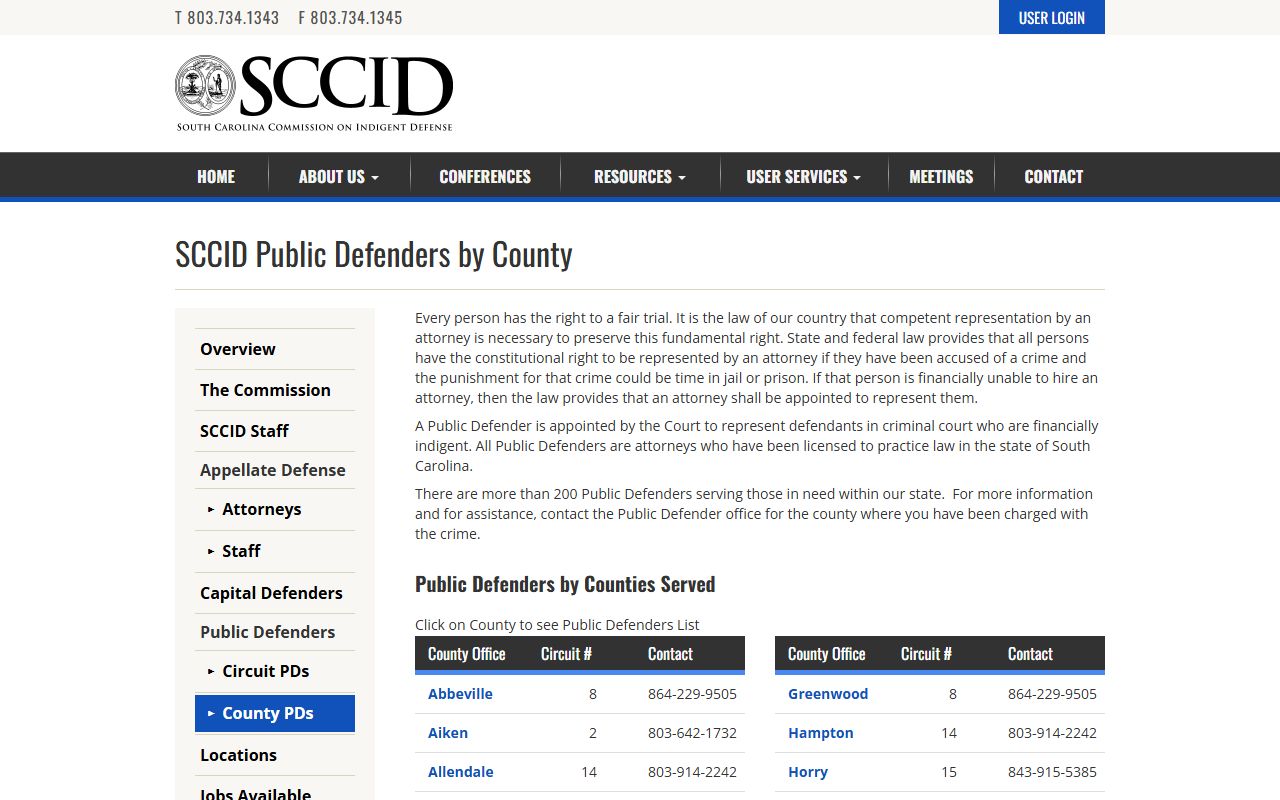
The public defender directory is relevant when charge status is pending and the person charged needs defense contact rather than a public record copy.
Solicitor and Public Defender Roles
South Carolina uses the title Solicitor for the elected prosecutor. Hampton County is served by the 14th Circuit Solicitor, whose office prosecutes General Sessions cases, certain Magistrate Court misdemeanors, and criminal cases in Family Court. The Hampton office is at the Hampton County Courthouse. The 14th Circuit Public Defender serves Allendale, Beaufort, Colleton, Hampton, and Jasper counties, and SCCID lists a Hampton County public defender contact for criminal charges.
14th Circuit Solicitor, Hampton Office
1 Elm St W.
Hampton, SC 29924
843-779-8689
Monday-Friday, 8:30 a.m.-5:00 p.m.
Hampton County Public Defender
Circuit 14
Hampton County, SC
803-914-2242
Criminal cases only. Public Defenders do not represent people in civil cases.
A charge record should be read with the prosecutor and court roles in mind. The Solicitor may pursue, amend, dismiss, or nolle pros charges, while the court records the disposition and sentence.